
Peptide Pens vs Lyophilised Vials: A UK Research Buyer's Guide
By Dr Peptide ·
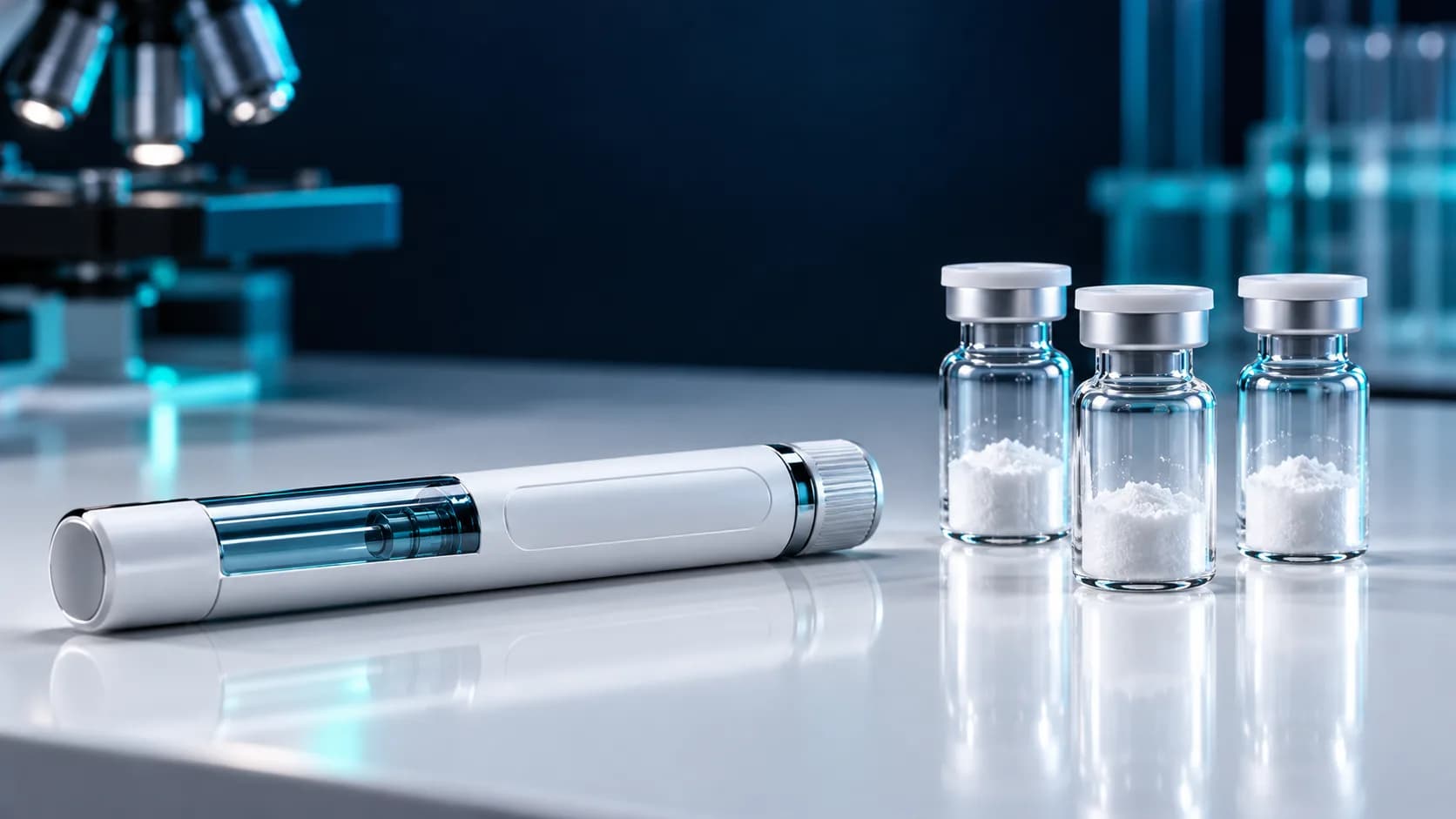
Research peptides are usually supplied in one of two formats: as a lyophilised (freeze-dried) powder in a sealed vial, or as a ready-made solution in a pre-filled pen. Both contain the same compound, but they suit different laboratory workflows. This guide compares the two formats so you can choose the right one for your protocol. All products discussed are supplied strictly for laboratory research use only.
What is a lyophilised peptide vial?
Lyophilisation removes water from the peptide under vacuum at low temperature, leaving a dry powder sealed in a sterile vial. In this dry state most peptides are considerably more stable than in solution, which is why vials are the standard format for longer studies and for keeping stock in reserve. Before use, the powder is reconstituted with a suitable diluent such as bacteriostatic water to a concentration chosen by the researcher.
Examples include our Retatrutide 20mg, Tirzepatide 20mg and GHK-Cu 50mg research peptides.
What is a pre-filled peptide pen?
A peptide pen holds the compound already dissolved at a fixed, known concentration, sealed in a cartridge with a mechanism that dispenses a consistent measured volume. There is no reconstitution step, which removes a source of variation between preparations and saves bench time.
Our peptide pen range includes Alluvi pens such as Alluvi Retatrutide 40mg and Alluvi Tirzepatide 40mg, and Synedica Retatrutide 40mg.
Pens vs vials at a glance
- Preparation: vials need reconstituting before use; pens are ready to use.
- Concentration: with a vial you choose the concentration; a pen's concentration is fixed by the manufacturer.
- Stability: lyophilised powder generally keeps longer than any solution. Once a vial is reconstituted or a pen is opened, follow the storage window on the label or Certificate of Analysis.
- Consistency: pens remove preparation-to-preparation variation; vials give more flexibility across different protocols.
Which format should you choose?
Choose lyophilised vials if your study needs flexible concentrations or long-term storage of reserve stock. Choose pre-filled pens if your protocol values speed and repeatability, or if several people prepare material and you want to remove reconstitution as a variable. Many laboratories keep both: vials for method development and pens for routine, repeated work.
Storage and handling
Store lyophilised vials refrigerated or frozen, sealed and protected from light, as stated for each product. Keep pens refrigerated and do not freeze them unless the label says otherwise. Whatever the format, record batch numbers and opening dates so results can be traced back to a specific lot.
Quality documentation
A Certificate of Analysis is available on request for both vials and pens. Orders ship from the UK with delivery in 1–3 business days on the mainland.
Browse peptide pens, GLP-1 research peptides or the full research catalogue. All products are supplied strictly for laboratory research use only and are not for human or veterinary use.
Like this? Tell Google you want more of it.