
Lyophilised Peptides Explained: A UK Research Guide
By Dr Peptide ·
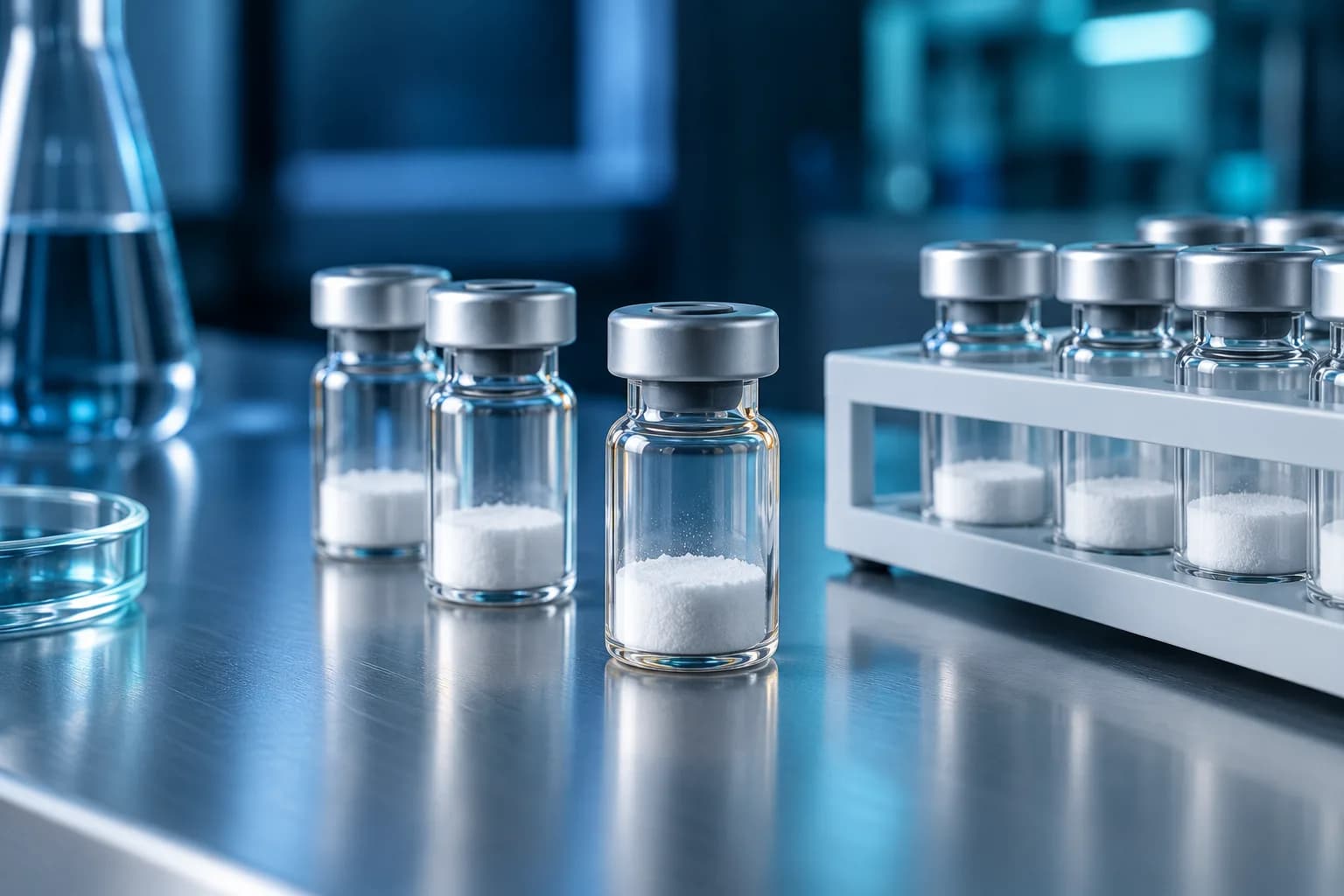
Most research peptides are supplied as a lyophilised (freeze-dried) powder sealed in a glass vial. If you are new to working with them, the small white "cake" at the bottom of the vial can raise questions: why is it supplied dry, how should it be stored, and what happens before it can be analysed? This guide explains the basics.
What does lyophilised mean?
Lyophilisation is the technical name for freeze-drying. It removes water from a product while it is frozen, so the material is dried without being exposed to high temperatures. The result is a dry, porous solid, often called a cake, that takes up very little space in the vial.
How freeze-drying works
Freeze-drying is usually described in three stages:
- Freezing. The peptide solution is cooled until it is completely frozen.
- Primary drying. The pressure is lowered to a vacuum and gentle heat is applied, so the frozen water turns straight into vapour (sublimation) without passing through a liquid stage.
- Secondary drying. The temperature is raised slightly to remove the small amount of water still bound to the solid.
The vial is then sealed with a rubber stopper and a crimped aluminium cap.
Why peptides are supplied freeze-dried
- Stability. Many peptides degrade faster in solution. Removing the water slows the chemical reactions that break them down.
- Storage. A dry powder is generally easier to store and transport than a liquid.
- Flexibility. The researcher chooses the volume of diluent, and so the final concentration, to suit their protocol.
Storing lyophilised vials
Always follow the storage conditions printed on the label. As general laboratory practice, keep sealed vials cool, dry and away from direct light, and avoid repeated temperature swings. Letting a refrigerated vial reach room temperature before opening it helps stop condensation forming inside. Our guide on how to store peptide pens and vials covers this in more detail.
Reconstitution in the laboratory
Before a lyophilised peptide can be analysed it has to be reconstituted, which means dissolving it in a measured volume of a suitable diluent. Bacteriostatic water is a common choice because its preservative allows a vial to be accessed more than once. Adding the liquid slowly down the inside wall of the vial and swirling gently, rather than shaking, helps keep the peptide intact. See Bacteriostatic water explained and our Bacteriostatic Water 10ml (laboratory grade).
Lyophilised vials vs pre-filled pens
Pre-filled peptide pens are supplied already in solution, so there is no reconstitution step. Vials need more preparation but give the researcher control over concentration. We compare the two formats in peptide pens vs vials, and you can browse our peptide pens and full research range.
Checking what is in the vial
A certificate of analysis (CoA) records the testing carried out on a batch, such as identity and purity results. Read what a certificate of analysis tells you and see the documents we hold on our certificates of analysis page.
Research use only
All Dr Peptide products are supplied strictly for laboratory research use. They are not medicines and are not for human or veterinary use. Please read our research use disclaimer before ordering.
Frequently asked questions
Why is my lyophilised peptide a small white cake?
That is normal. Freeze-drying leaves the peptide as a dry, porous solid at the bottom of the vial. The amount of visible powder can look very small, because research quantities are measured in milligrams.
Can the powder look different between vials?
Yes. The cake can be compact, fluffy, or partly broken up from movement in transit. Appearance alone does not indicate quality. The batch documentation is the reliable reference.
Do lyophilised peptides need to be refrigerated?
Follow the label. Many sealed lyophilised vials are kept cool and dry, and storage needs usually change once a peptide has been reconstituted.
Is a pre-filled pen the same compound as a vial?
The compound can be the same, but the format differs. A pen is supplied in solution, while a vial is a dry powder that needs reconstitution. Check each product page for the exact contents.
Like this? Tell Google you want more of it.